In brief
- Artificial intelligence (AI) refers to computer programs that can perform tasks that normally require human intelligence: understanding text, recognizing images, translating, recommending, deciding.
- Almost all the AI you come across today is built on machine learning: instead of writing rules by hand, we let the machine work them out from a very large number of examples.
- Today’s AI systems, like ChatGPT, Claude, or Gemini, are “narrow” AI: very strong in their domain, but with no consciousness and no understanding of the world comparable to ours.
On this page
A simple definition of AI
Artificial intelligence is a set of techniques that allow a machine to imitate certain abilities associated with intelligence: perceiving, learning, reasoning, communicating, or deciding. The term was proposed in 1955 by the American researcher John McCarthy, then popularized at the Dartmouth workshop in the summer of 1956.
There is no single definition, and that’s normal: we tend to stop calling a technique “AI” as soon as it becomes commonplace. In the 1990s, a program able to beat a chess champion seemed to belong to AI; today, nobody marvels at a spell checker or a spam filter, even though both are examples of it.
AI, machine learning, deep learning, generative AI: what’s the difference?
These terms nest inside one another like Russian dolls. AI is the big umbrella; each following term is a more specific subset of the one before.
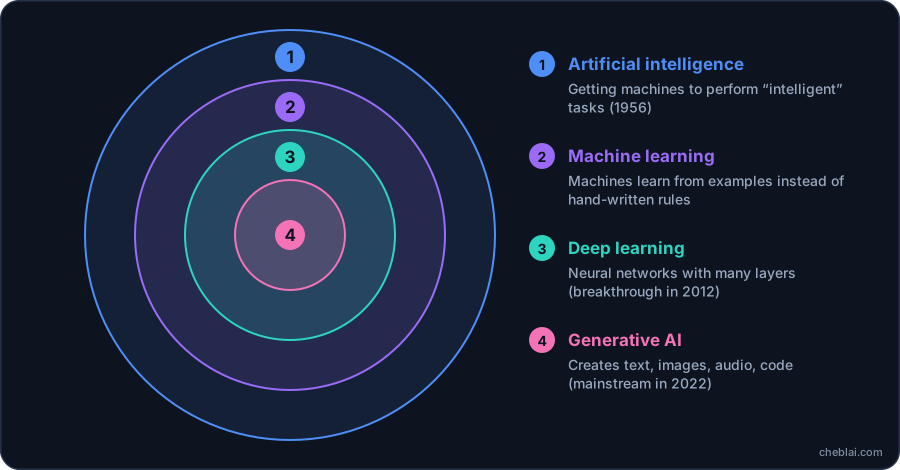
- Artificial intelligence: the overall goal (getting a machine to perform “intelligent” tasks). It includes older, rule-based approaches.
- Machine learning: the machine learns from data instead of being programmed rule by rule. This is the core of today’s AI.
- Deep learning: a family of learning techniques that uses artificial neural networks with many layers. It is what made the major breakthroughs since 2012 possible.
- Generative AI: deep learning models that produce new content (text, images, audio, video, code) instead of just classifying or predicting. ChatGPT, Midjourney, and ElevenLabs are examples.
To go deeper into each level, see how an AI works, how it learns, and generative AI for images, video, and audio.
Examples of AI you already use
AI is not a technology of the future: it is already built into most everyday digital tools, often without our noticing.
| Situation | What the AI does | Example tool |
|---|---|---|
| Writing or summarizing text | Generates and rephrases text from a prompt | ChatGPT, Claude, Gemini |
| Translating | Translates while taking the context of the sentence into account | DeepL |
| Looking up information | Searches the web, then synthesizes the results with sources | Perplexity AI |
| Creating an image | Produces an image from a description | Midjourney, Stable Diffusion |
| Generating a voice | Turns text into a realistic voice | ElevenLabs |
| Programming | Suggests and writes code | GitHub Copilot, Cursor |
| Unlocking your phone, sorting your photos | Recognizes a face, a person, an object | Smartphones (image recognition) |
| Watching a series, listening to music | Recommends content based on your tastes | Streaming platforms |
You can browse hundreds of tools in our AI tools directory, organized by use case and rated against our criteria.
“Narrow” AI and “general” AI: where do we stand?
Researchers distinguish between two broad categories. This distinction clears up a lot of misunderstandings.
- Narrow AI (or “weak” AI): designed for specific tasks. All of today’s systems fall into this category, even those that seem very versatile, like conversational assistants.
- General AI (AGI, artificial general intelligence): a hypothetical AI able to adapt to any intellectual task with the flexibility of a human. It does not exist today, and specialists agree neither on how to define it nor on when it might appear, if it ever does.
What AI does well… and what it does poorly
Understanding AI’s strengths and weaknesses helps you use it wisely.
| AI is generally very good at | AI is generally fragile at |
|---|---|
| Spotting patterns in large amounts of data | Verifying the truth of what it claims |
| Rephrasing, summarizing, translating, sorting | Reasoning reliably about unfamiliar situations |
| Quickly producing a first draft (text, image, code) | Knowing about events after its training, unless it searches the web |
| Working tirelessly on repetitive tasks | Making ethical decisions or decisions that carry responsibility |
Why has AI been progressing so fast in recent years?
The basic ideas behind AI date from the 1940s to the 1980s. What changed around 2012 was the coming together of three ingredients:
- Lots of data
The internet, smartphones, and social networks produced gigantic amounts of text, images, and videos. An annotated image database like ImageNet, introduced in 2009, played a decisive role.
- Far more computing power
Graphics processing units (GPUs), designed for video games, turned out to be ideal for training neural networks. In 2012, the AlexNet network was trained on just two consumer graphics cards.
- Better algorithms
More efficient training techniques, then the Transformer architecture published in 2017 by Google researchers, made it possible to build far more powerful language models.
The details of this evolution, with its dates and key players, are told in the history of artificial intelligence.
Where should a beginner start?
The best way to understand AI is to use it, with a critical eye. Try a free assistant on a concrete task (summarizing an article, rewording an email), then always check the result. Our selection of free AI tools lets you get started without paying, and the beginner’s guide gives you good habits from the start.
Frequently asked questions
What is the definition of artificial intelligence in one sentence?
Artificial intelligence is the set of techniques that allow a machine to perform tasks normally associated with human intelligence, such as understanding text, recognizing images, translating, or making decisions.
What is the difference between AI and machine learning?
AI is the broad field; machine learning is the subset of techniques in which the machine learns from examples rather than following rules written by hand. Most of today’s AI is based on machine learning.
Is ChatGPT real intelligence?
ChatGPT is a generative AI of the language-model type: it produces text by predicting the most likely words based on gigantic amounts of text. It is very useful, but it does not understand the world the way a human does and can be confidently wrong.
Who invented artificial intelligence?
There is no single inventor. Alan Turing laid the theoretical foundations in 1950, and the term “artificial intelligence” is credited to John McCarthy, who proposed it in 1955 and popularized it at the Dartmouth workshop in 1956.
Will AI replace humans?
Today’s AI automates tasks, not entire jobs, and it needs to be supervised. Its effect on employment varies by sector and is debated among economists. Learning to use AI is a useful skill today.